
Creating Secure REST APIs with Laravel
Learn the key practices I use to build secure and maintainable REST APIs in Laravel, including authentication, validation, authorization, error handling, and API resource design.
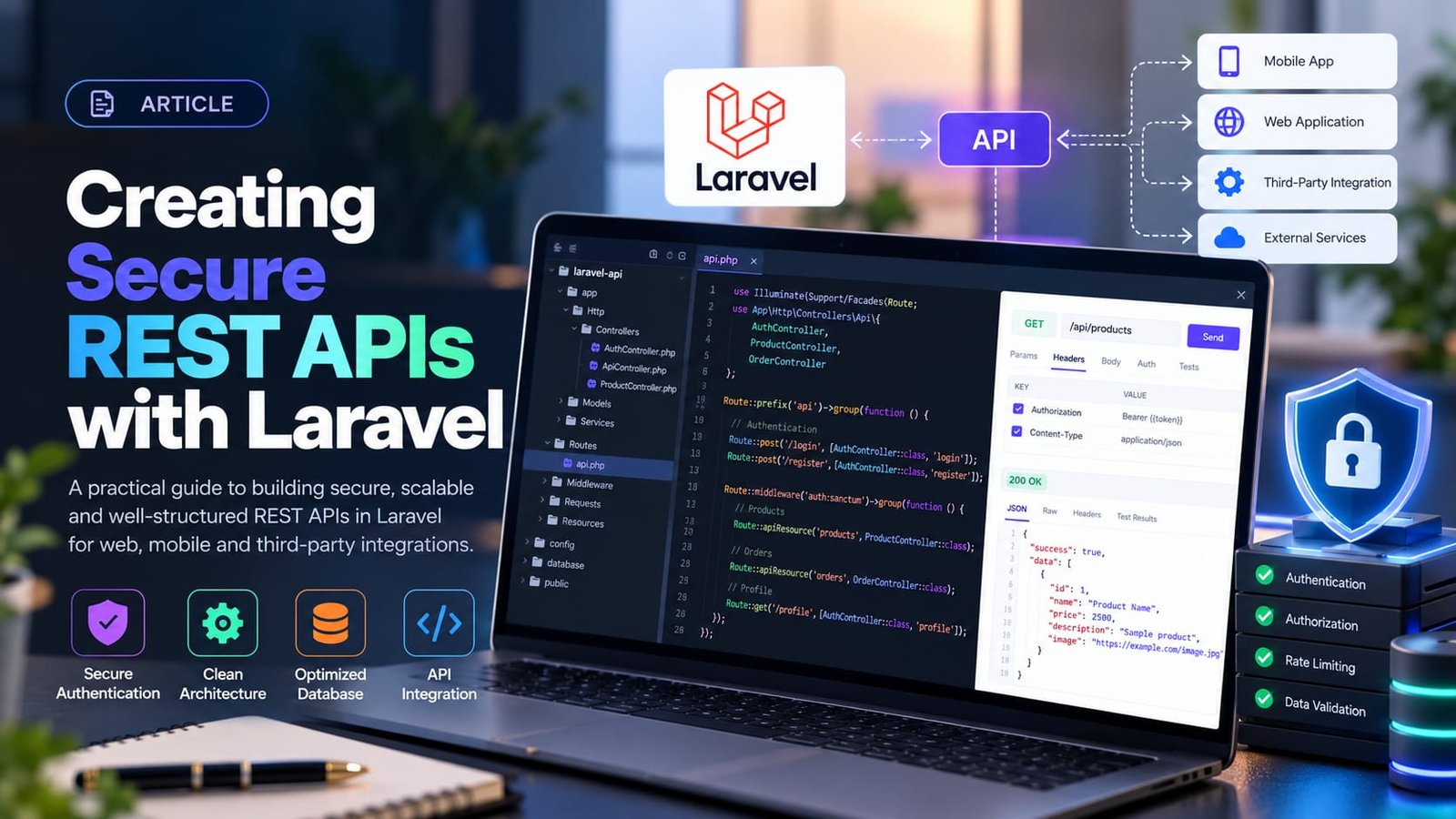
Learn the key practices I use to build secure and maintainable REST APIs in Laravel, including authentication, validation, authorization, error handling, and API resource design.
ARTICLE BODY & SPECIFICATIONS
REST APIs are an important part of modern web and mobile applications. They allow frontend applications, mobile apps, external systems, and third-party services to communicate with a backend securely.
Laravel provides an excellent foundation for API development because of its routing, validation, authentication, middleware, resources, and database features.
When building a Laravel API, I start by creating clear and predictable endpoints.
For example, product-related endpoints may follow structures such as /api/products, /api/products/{id}, and /api/categories.
Request validation is essential. Every incoming request should be validated before data is processed or stored.
Laravel Form Requests make it easier to keep validation logic organized and separate from controllers.
Authentication is normally handled using Laravel Sanctum, Passport, or another token-based authentication method depending on the project's requirements.
After authentication, authorization determines what each user is allowed to do.
Laravel policies and gates are useful for controlling access to resources such as orders, reports, users, and administrative modules.
API responses should also remain consistent. Successful responses and errors should follow a predictable structure so frontend developers can work with them easily.
Laravel API Resources are useful for controlling exactly which fields are returned and how relationships are formatted.
Security also includes rate limiting, secure token handling, CORS configuration, protection against unauthorized access, and avoiding exposure of sensitive database fields.
For applications that communicate with third-party systems, API credentials should be stored securely in environment variables or encrypted configuration fields.
Logging is also important for identifying failed API calls, authentication issues, synchronization problems, and unexpected application errors.
A well-designed REST API should be secure, predictable, properly documented, scalable, and easy for other developers or applications to consume.

Musab Afzal
Full Stack Web Developer
Full Stack Web Developer with 2+ years of experience building and maintaining web applications using Laravel, Core PHP, and modern front-end frameworks. Skilled in WordPress theme development, responsive UI design with Tailwind CSS and Bootstrap, and building REST APIs. Currently expanding into Next.js, React.js, and React Native for cross-platform development.
Enjoyed this technical breakdown?
Hire me to engineer similar architectures for your product or check out our client packages.